

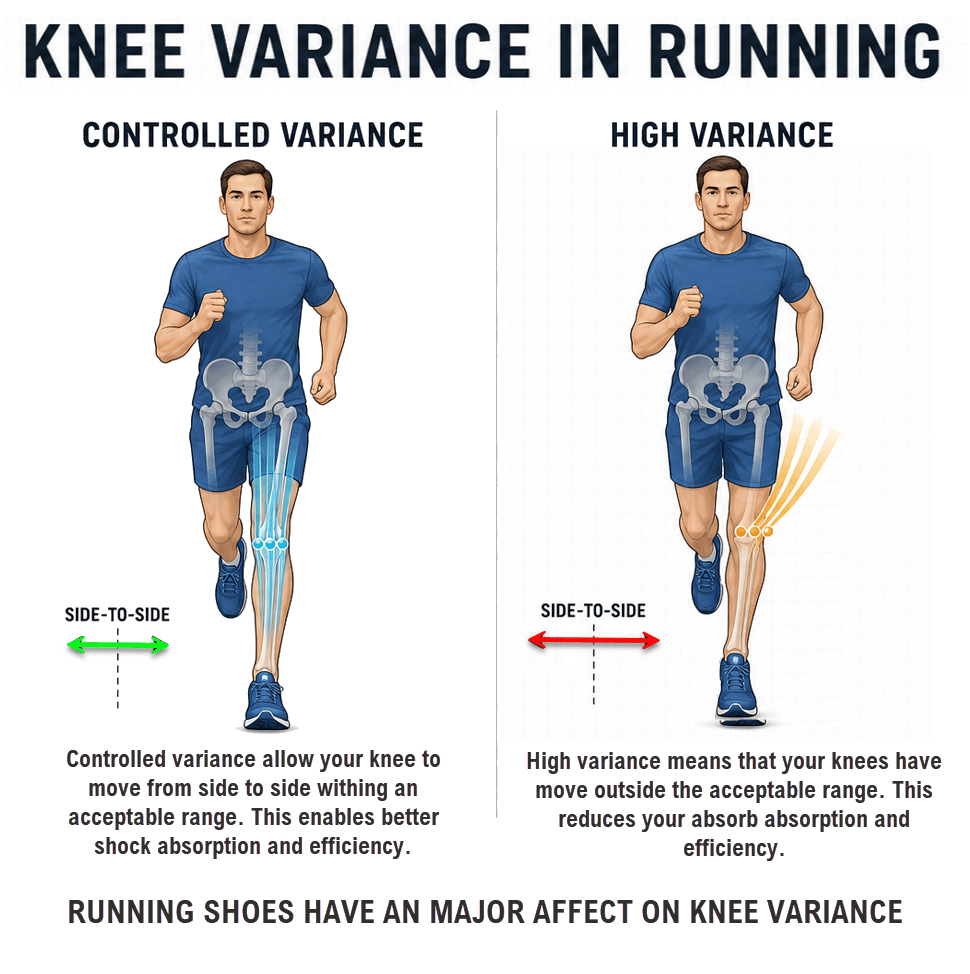
When we run, the knee does not simply bend and straighten like a hinge. It also moves slightly from side to side and rotates as the body absorbs impact, stabilises and moves forwards.
This natural movement is essential. The challenge is determining when it represents normal adaptation—and when it may indicate that the runner is struggling to control the leg.
What is knee variance?
In running analysis, knee variance describes how much the knee’s position or movement changes during repeated steps. Depending on the measurement system, it may refer to:
- Side-to-side movement of the knee during stance.
- Differences between the left and right legs.
- Changes from one stride to the next.
- The consistency of the knee’s movement pathway.
Knee variance is therefore not simply another name for knee angle. A runner may produce a perfectly acceptable knee angle on one recorded stride but follow a noticeably different pathway on the next.
That repeatability—or lack of it—can provide useful information about how well the runner is controlling their movement.
Is knee variance good or bad?
Some variability is completely normal. In fact, the human body is designed to make small adjustments from one step to the next.
A perfectly identical movement repeated thousands of times could continually load the same tissues in precisely the same way. A small amount of natural variation may help distribute that load across muscles, tendons, bones and joints.
Therefore:
Low knee variance does not automatically mean good, and high knee variance does not automatically mean bad.
The result must be interpreted alongside the runner’s speed, fatigue, injury history, strength, stability and overall running pattern.
Research also suggests that variability is not universally harmful. In runners with patellofemoral pain, certain footwear or gait changes have sometimes increased hip and knee variability while improving the way load is distributed. This reinforces the point that variability needs context rather than a simple pass-or-fail threshold. PubMed study
What might “good” knee variance look like?
Healthy knee movement will generally appear controlled but not artificially rigid. The runner should be able to:
- Maintain a reasonably consistent knee pathway.
- Control the thigh as the body moves over the supporting foot.
- Adapt naturally to changes in speed and surface.
- Continue running without movement becoming progressively less controlled.
- Produce broadly comparable movement between the left and right sides.
The key word is controlled. The knee can move without being unstable.
When could knee variance become a concern?
Higher or increasing knee variance may suggest that the runner is finding it difficult to control the leg, particularly if it is accompanied by:
- Excessive inward or outward knee movement.
- Large differences between consecutive strides.
- A marked imbalance between the two legs.
- Increasing movement as the runner becomes tired.
- Poor control of the pelvis or centre of mass.
- Pain or a history of recurring knee injury.
This does not prove that an injury will occur. Running injuries are multifactorial, and no single biomechanical measurement can reliably predict them.
However, excessive or inconsistent knee movement may highlight a potential weakness in the runner’s movement strategy. Possible contributors include reduced hip strength, fatigue, previous injury, poor coordination, inappropriate running speed—or the running shoe itself.
How can running shoes affect knee variance?
A running shoe changes the interface between the runner and the ground. Altering the cushioning, geometry, platform width, heel-to-toe drop, rocker, foam density or stiffness can change how forces travel through the ankle, knee and hip.
Research shows that different footwear conditions can alter knee flexion, knee moments and the amount of work performed at the knee. Importantly, even minimalist footwear does not necessarily reproduce barefoot mechanics. Bonacci et al.
A shoe may reduce knee variance if it:
- Provides a platform that works well with the runner’s preferred movement.
- Allows the foot and lower leg to progress smoothly.
- Improves whole-body stability.
- Reduces the muscular effort required to control each landing.
However, another shoe may increase knee variance if its geometry, softness or stiffness disrupts the runner’s preferred movement pathway.
A highly cushioned shoe, for example, may feel comfortable but still require more active stabilisation. A very stiff or strongly rockered shoe may improve movement for one runner while forcing another runner to compensate farther up the leg.
Even apparently small design changes can alter lower-limb mechanics. This is why shoes should not be judged solely by category, cushioning level or marketing claims.
Do “support” shoes automatically control the knee?
No.
Traditional shoe selection often assumes that controlling foot pronation will automatically improve knee alignment. In reality, the relationship between foot motion and knee movement is considerably more complicated.
Motion-control shoes can alter rearfoot and knee mechanics in some populations, but the response is not consistent enough to assume that every runner needing greater knee control should receive a “support” shoe. Motion-control footwear study
A shoe labelled stable may reduce knee variance in one runner, produce no meaningful change in another and increase it in someone else.
The label describes the shoe—not the runner’s response to it.
Knee variance should be measured while running
Static foot scans, arch measurements and standing assessments cannot show how consistently the knee is controlled during running.
Even a single video frame may be misleading. Knee variance requires movement to be recorded across multiple consecutive strides, ideally:
- At the runner’s appropriate speed.
- After sufficient time to become accustomed to the shoe.
- In several different shoe models.
- As part of a wider assessment of the whole body.
It should then be considered alongside measurements such as dynamic stability, braking, ground-contact time, cadence, overstride and knee flexion.
The real value is in comparing shoes
There is currently no universal knee-variance number that identifies the “perfect” running shoe for everyone. The most useful question is not:
“Is this runner’s knee variance good or bad?”
It is:
“How does this runner’s knee variance change when they run in different shoes?”
If one shoe produces a more controlled and repeatable knee pathway—without negatively affecting comfort or other important metrics—that shoe may be better suited to that individual.
This is where objective 3D analysis becomes valuable. RUNRIGHT-3D compares the runner’s movement across different shoes rather than assuming that a particular foot type requires a particular shoe category.
The bottom line
Knee variance is not something that should automatically be eliminated. A degree of variability is natural and may even be beneficial. The concern is movement that becomes excessive, poorly controlled, markedly asymmetrical or progressively worse with fatigue.
Running shoes can influence that movement—but their effect is highly individual.
The best shoe is therefore not necessarily the one described as the most stable. It is the one in which the individual runner demonstrates the best combination of comfort, control, stability and overall movement.